
Bay’s Earthquake-Resilient Designs
Recent seismic activity has reminded us of the importance of thoughtful, resilient design. At Bay, ensuring the safety and peace of mind of our residents is central to every decision we make.
Our buildings are designed to exceed the seismic standards of the Bangladesh National Building Code (BNBC), incorporating detailed foundation design based on physical soil investigations, high-strength concrete and rebar with precise detailing, strategically positioned shear walls, and robust lateral load management to maintain overall structural integrity.
Beyond compliance, we conduct additional testing at our Bay Testing & Research Laboratory (BRTL) to meet ASTM standards, ensuring that materials and construction practices are continuously monitored for quality and safety.
We also engage expert consultants to review structural, electrical, mechanical, and plumbing systems, providing an added layer of assurance. These proactive measures are part of our ongoing commitment to creating living spaces where residents can carry on their daily lives with confidence and peace of mind.
At Bay, safety is not just a standard—it is quietly integrated into every design, every material, and every process, so resilience and comfort go hand in hand.


What Richter scale earthquake can a building withstand?
We often think earthquake safety depends on the “Richter scale,” but that number alone doesn’t tell us how a building will perform.
The real impact of an earthquake depends on many factors. The major factors would be
- how close you are to the epicenter,
- how deep the quake is,
- the condition of soil beneath the building,
- and, most importantly, how the building is designed.
The recent quake felt strong in Dhaka not because the magnitude was high, but because the epicenter was nearby and the depth was shallow.
How buildings are designed?
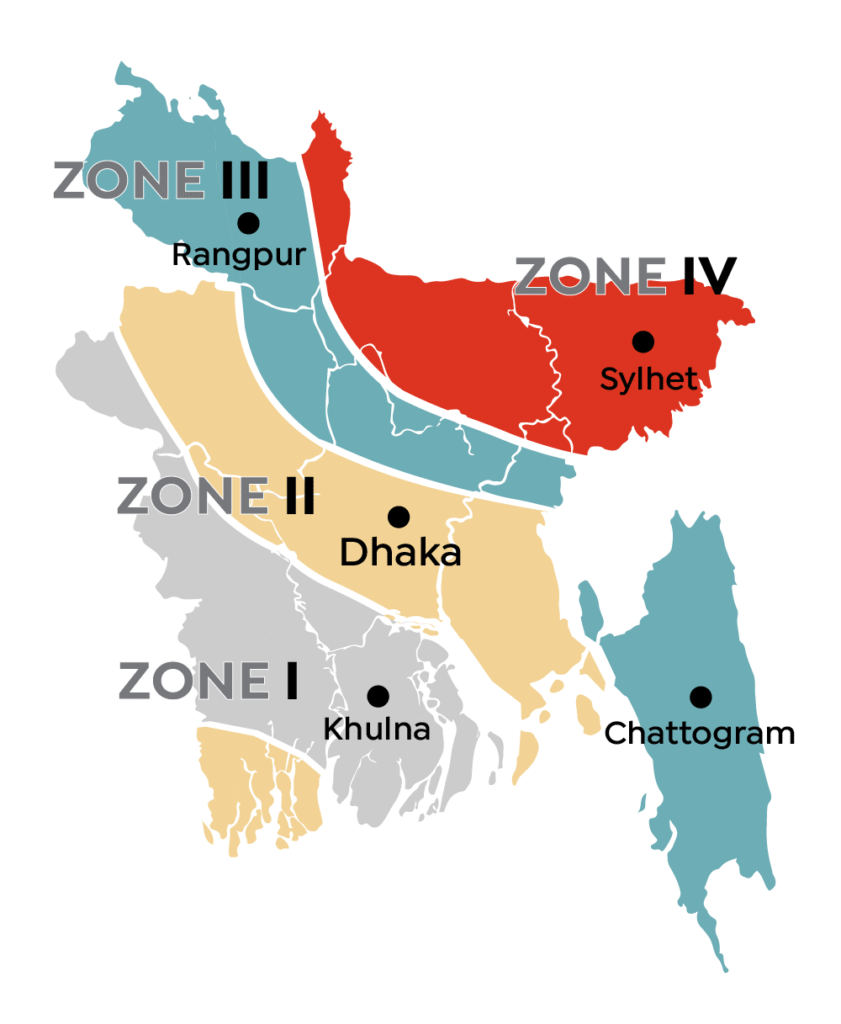
Areas like Sylhet, Mymensingh, and the northeastern belt fall in Zone IV, the highest-hazard zone.
This corresponds to stronger expected shaking (up to 0.36g on firm ground), which is why buildings there have stricter design requirements.
What Magnitude Can a Building Survive?
There is no single Richter number a building is “rated” for.
Instead, a building in Bangladesh is designed according to its seismic zone, ensuring it can withstand the level of shaking scientifically expected for that region, whether the earthquake is magnitude 5 or 7.
Where Does Dhaka Fall?
Dhaka is in Zone II, a moderate seismic intensity zone.
Buildings in this zone are designed for ground shaking up to 0.20g (depending on soil and building type).
What are the Highest-Risk Regions in Bangladesh?
Areas like Sylhet, Mymensingh, and the northeastern belt fall in Zone IV, the highest-hazard zone.
This corresponds to stronger expected shaking (up to 0.36g on firm ground), which is why buildings there have stricter design requirements.